The Pas d’Armes: Chivalry as Performance
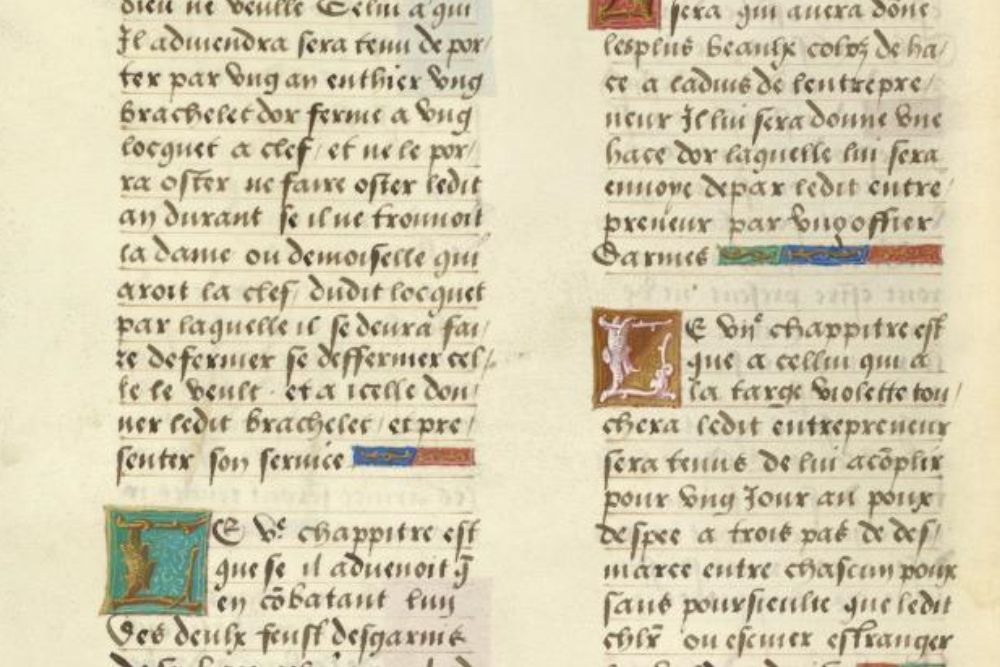
The pas d’armes was the most theatrical form of the medieval tournament: one knight held a bridge, a gate or a fountain against all comers, under published rules, inside a story borrowed from romance. It flourished in the fifteenth century, from Castile to Burgundy, and it is one of the best-documented settings we have for real knightly combat with lance, axe and sword.
For anyone training historical swordsmanship, it matters because it shows the knightly arts as they were actually performed: in armour, before a crowd, to set rules, with reputations on the line.
Where it came from
The name likely comes from a crusading legend. The thirteenth-century Pas Saladin told how Philippe Auguste of France, with twelve knights including Richard I of England, held a narrow pass near Jerusalem against Saladin.
The format also grew out of literature. Tournaments at Le Hem (1278) and Chauvency (1285) had knights playing Lancelot and Gawain, and some events called themselves “Round Tables”. Romances went further: in Ponthus et Sidoine, the hero defends a fountain in the forest of Broceliande against four knights a month for a year, for love of his lady. That is a pas d’armes in all but name.
The first real pas were staged at the courts of Castile and Aragon in the early fifteenth century. From the mid-1440s the dukes of Anjou and Burgundy made them their own, and they stayed popular in northern France into the 1530s. Recent research has found them in Savoy and even at the Scottish court in the early 1500s, but never in England or the German-speaking courts.
How a pas worked
Three features set the pas d’armes apart from the ordinary joust or tourney:
- A defended place. The organiser, the entrepreneur, held a passage (a bridge, a gate) or a symbolic object (a fountain, a column, a tree) against all challengers, alone or with companions.
- Chapters of arms. Written rules were circulated in advance by heralds, court to court. They set the weapons, the number of courses or blows, the prizes and the forfeits.
- A story. Each pas had a fictional frame, usually drawn from romance, with the knight acting at a lady’s command or in her defence.
The ritual was simple and visual. A challenger announced himself by touching or striking a shield hung at the site, and the shield he chose decided the form of combat. Bouts were fought before a mixed audience of nobles and townspeople, men and women, with judges and heralds recording every blow.
Famous pas d’armes
| Date | Pas | Place | Entrepreneur | The hook |
|---|---|---|---|---|
| 1493 | Pas de Sandricourt | Sandricourt, France | Louis de Hédouville | Bonded the knights who would invade Italy with Charles VIII in 1494 |
| 1468 | Pas de l’Arbre d’Or | Bruges | Antoine, Bastard of Burgundy | Staged for the wedding of Charles the Bold and Margaret of York |
| 1463 | Pas du Perron Fée | Bruges | Philippe de Lalaing | The knight claimed to be the prisoner of a fairy lady, fighting for his freedom |
| 1449–50 | Pas de la Fontaine des Pleurs | Chalon-sur-Saône | Jacques de Lalaing | Fought for the “Lady of Tears”, a figure of the beleaguered Church in the Holy Land |
| 1449 | Pas de la Bergère | Tarascon | René of Anjou’s court | A pastoral fantasy, with a shepherdess guarding her flock |
| 1446 | Pas de la Joyeuse Garde | Saumur | René of Anjou | Named after Lancelot’s castle, an open nod to Arthurian romance |
| 1434 | Paso Honroso | Órbigo Bridge, León | Suero de Quiñones | Held a bridge for a month to free himself from a vow of love |
Jacques de Lalaing’s pas is the one to know. For a year he held a pavilion by a fountain, with a lady weeping into it. Challengers chose a white, violet or black shield to fight with axe, sword or lance. Lalaing became the model knight of his age, and was killed by a cannonball at the siege of Poeke in 1453.
The fighting
A pas could include any form of tournament combat, mounted or on foot. The chapters fixed exactly what was allowed.
- The joust. Courses with lances, usually counted in lances broken. By the mid-fifteenth century a barrier, or tilt, often separated the riders. At the Paso Honroso the target was 300 broken lances.
- Foot combat with the axe. The pollaxe was the signature foot weapon of the Burgundian pas. Bouts were set at a fixed number of blows, and ended early if a man was disarmed or brought to the ground.
- Foot combat with the sword. Fought in full harness, with thrusts to the gaps and blows to unbalance as much as to wound.
This was real fighting with sharp or lightly rebated weapons, in armour built for the purpose. Injuries were common. The rules made it survivable, not safe.
Why knights staged them
The story said love. The reasons were usually political:
- Settling rivalries. Factions could fight inside the lists instead of in open war. The Paso Honroso set Castilians against Catalan and Aragonese knights.
- Climbing at court. A good showing could win favour, and even a place in an order like the Golden Fleece. That may have been Philippe de Lalaing’s real aim in 1463.
- Building a fighting company. Sandricourt brought together the knights Charles VIII would lead into Italy.
- Selling a cause. Jacques de Lalaing’s Lady of Tears was crusade propaganda in costume.
For the dukes of Burgundy, the pas was also a display of wealth. Pavilions, costumes, heralds and feasts showed every visiting ambassador what kind of court they were dealing with.
What it means for the modern sword student
The pas d’armes is the closest medieval parallel to how we train and compete today. Agreed rules, set weapons, a fixed number of exchanges, judges, an audience. The knights of Chalon and Bruges would recognise a modern HEMA tournament.
The chronicles also preserve how these fights actually went: who closed, who was thrown, whose axe was struck from his hands. Read alongside the fight books, they show the techniques we study being used under pressure, in armour, by men whose reputations depended on them.
If you train with the longsword, the pollaxe or in harness, the pas d’armes is your history. Come and train with us and find out what it takes.
Sources and further reading
- The Joust as Performance: Pas d’armes and Late Medieval Chivalry — virtual exhibition
- Olivier de La Marche, Mémoires — eyewitness accounts of the Burgundian pas
- Livre des faits de messire Jacques de Lalaing — the biography of Jacques de Lalaing, including the Fontaine des Pleurs
- René of Anjou, Traité de la forme et devis d’un tournoi — the illustrated tournament treatise