Masters of the Sword: Peter Falkner and Hans Medel
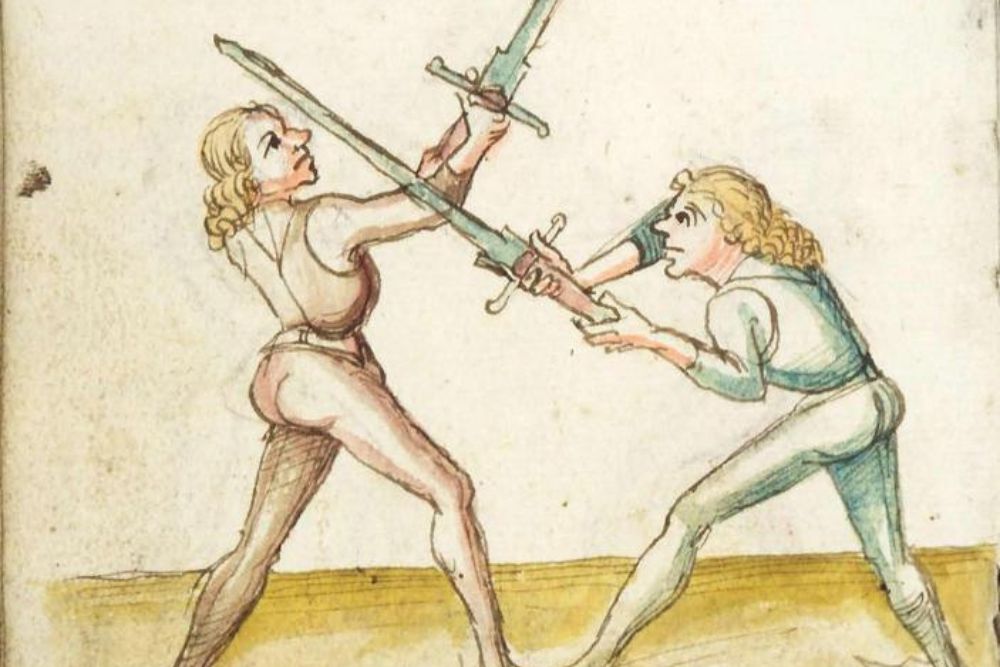
Two late-medieval fencing masters, one shared tradition — and a body of work that still informs practice today.
The World They Inhabited
The second half of the fifteenth century was a golden age for the German fencing tradition. The Liechtenauer system, named for the great synthesiser Johannes Liechtenauer, whose cryptic verse Zettel underpinned virtually all serious longsword teaching of the era, was spreading, being interpreted, debated, and refined by a new generation of masters. Two of the most significant figures to emerge from this period were Peter Falkner of Frankfurt and Hans Medel von Salzburg. Though they operated in different institutional contexts, both left manuscripts that give us a uniquely detailed window into how the art was being taught, argued about, and developed at the close of the medieval period.
Peter Falkner: Captain of the Marxbrüder
Who Was He?
Peter Falkner (also recorded as Peter Faulkner or Petter Falckner) was born around the 1460s and remained active at least until 1506. His early life is uncertain, but he was certified as a Master of the Long Sword by the Marxbrüder (the Brotherhood of Saint Mark) in Frankfurt-am-Main some time before 1491.
The Marxbrüder were one of the two great German fencing guilds of the late medieval period, and certification as a master by them was no small thing. It required demonstrating genuine mastery of the art before the guild’s senior membership. Falkner evidently impressed them: he was a witness of record to the guild’s biannual treasury accounting in 1496, a task he performed again in 1506. More significantly still, in 1502 he was elected as Captain (Hauptman) of the guild, and he seems to have served an unusual three consecutive terms. Holding the captaincy of the Marxbrüder was essentially the highest position available to a German fencing master of his era.
The Manuscripts
In the 1490s, Falkner seems to have produced at least two manuscript fencing manuals, becoming the first member of the Brotherhood of Saint Mark to do so (unless Hans Talhoffer were also a member).
The major surviving work is Kunste Zu Ritterlicher Were (MS KK5012 — “Arts of Knightly Defence”). This fully illustrated manuscript includes a sword section based on Liechtenauer’s Recital and a messer section based on that of Johannes Lecküchner, though in both cases with considerable alteration and elaboration by Falkner, and several short sections on other weapons which appear to be entirely original.
It’s that last point worth dwelling on. Falkner wasn’t simply copying the tradition — he was actively adapting and expanding it. His messer material in particular draws heavily on Lecküchner’s system but processes it through his own lens, producing something distinctly his own. The artwork in the manuscript is also notable: Falkner’s artwork resembles to some extent the earlier treatises of Paulus Kal, which may have been his inspiration, and his art seems in turn to have influenced Jörg Wilhalm.
The second, larger manuscript, known as the Falkner Turnierbuch, is a significant loss to HEMA scholarship. It seems to have been destroyed by Prussian bombardment during the Siege of Strasbourg in 1870. What little we know about its contents comes from records made before this time, which seem to indicate a manuscript of at least 111 folia containing an anthology of treatises by other masters of the Liechtenauer tradition, as well as a few works of unknown origin.
There is also a possible third Falkner manuscript, the apparently anonymous MS Cl. 23842, whose illustrations bear a strong resemblance to the artwork in KK5012 and which seems to even directly allude to it.
Why Falkner Matters
Falkner represents the guild system at its most functional. He wasn’t an isolated scholar or a private teacher to a noble household — he was a guild captain, an institutional leader, and a practitioner who put his knowledge into written form when very few others in his brotherhood had done so. His manuscripts give us a picture of how the Liechtenauer tradition was being understood and transmitted within a professional fencing culture, and his willingness to depart from received glosses tells us that even within the guild, individual interpretation was expected and valued.
Hans Medel von Salzburg: The Debating Master
Who Was He?
Hans Medel von Salzburg (also recorded as Hans Niedel or Hans Mendel) was a fifteenth-century German fencing master. Little is known about this master, but he seems to have been associated with the tradition of Johannes Liechtenauer.
What makes Medel particularly interesting is his relationship to the broader tradition — specifically, to an earlier master named Hans Seydenfaden von Erfurt. He may have traced his lineage through Seydenfaden, a member of the Fellowship of Liechtenauer, as Medel’s text is the only known source that mentions teachings from that earlier master. The chain of transmission from Liechtenauer through Seydenfaden to Medel, if it holds, places Medel within one of the more obscure branches of the tradition.
The Manuscript
Medel’s name is attached to a manuscript fencing treatise from the late fifteenth or early sixteenth century, including an incomplete gloss of Liechtenauer’s Recital on the long sword and an addendum on fencing based on “the Seven Stances.” It seems to have been written by a student or associate of Medel rather than the master himself.
The manuscript’s provenance is itself a small story. It eventually passed into the library of Paulus Hector Mair, who seems to have acquired it in 1539 and bound it into the current Codex I.6.2º.5 some time after 1566. Unfortunately, the extant fragment of the gloss terminates abruptly at the beginning of the section on drawing back, and the remainder is currently lost.
The text survives in a collection that also bears Mair’s extensive programme of commissioned illustrations — themselves visually similar to Medel’s own artwork, suggesting Mair may have been directly inspired by the manuscript he acquired.
A Master Who Argued with His Sources
What sets the Medel gloss apart from most other Liechtenauer commentaries is its critical, engaged relationship with earlier glosses. This gloss is unique in the Liechtenauer tradition in that it not only offers unique commentary on the Recital, but also both quotes and occasionally criticises or corrects the earlier glosses of Sigmund ain Ringeck and Nicolaüs.
That’s a remarkable thing to do. The Ringeck gloss was one of the most authoritative commentaries in the tradition. Medel — or his student writing on his behalf — wasn’t content simply to transmit it; he pushed back on specific points, offering alternative interpretations and noting where he felt Ringeck and others had got it wrong. The result is one of the most textually rich sources we have for understanding how masters of the period actually engaged with the tradition as a living, contested body of knowledge rather than fixed doctrine.
The gloss specifically describes a teaching of Hans Seydenfaden von Erfurt or Hans Medel in a few places, but in several more it merely attributes the teaching to “Master Hans” without indicating which one. This ambiguity is one of the productive puzzles of the manuscript — scholars still debate which “Master Hans” is being referenced in various passages, and the answer matters for understanding the lineage of specific techniques.
The manuscript’s introductory framing makes the transmission explicit. The preface describes how Sigmund ain Ringeck had first glossed Liechtenauer’s Recital for Duke Albrecht of Bavaria, and that the work was subsequently “enriched and improved by other masters, and especially through Master Hans Medel from Salzburg.” Medel is positioned, in other words, not as a rival to the tradition but as someone who developed it further — a distinction his critical commentary richly bears out.
The Illustrations
The illustrations in Medel’s treatise are very similar to the earlier Cluny Fechtbuch (Cl. 23842) — which also includes brief notes that might refer to Medel’s teachings — as well as to the paintings Paulus Hector Mair would later commission for his own manuscripts, and may have been an inspiration for them. This places Medel’s visual tradition at something of a junction point: inheriting from one earlier document and influencing a later one.
Two Masters, One Tradition
Falkner and Medel are often studied separately, but placing them side by side reveals something important about the Liechtenauer tradition in the late fifteenth century. Neither of them was simply preserving an inherited system. Both were practitioners who engaged actively with the material, adapted it, and left written records that reflect genuine intellectual investment in the art.
Falkner, as guild captain and institutional insider, worked from within the professional fencing establishment. Medel, operating somewhat more independently and drawing on a less well-documented lineage, brought a critical, questioning voice that challenged even well-established glosses. Together they represent the range of approaches through which the tradition reproduced and renewed itself.
For modern HEMA practitioners, both sources remain actively useful. Falkner’s Kunste Zu Ritterlicher Were is one of the key illustrated manuals for longsword and messer practice. Medel’s gloss — especially read alongside Ringeck’s — offers a rare opportunity to see how two masters of the same tradition can reach genuinely different conclusions from the same source material, and in doing so, forces practitioners to think harder about what the techniques are actually doing.
That kind of productive argument is, in the end, what serious martial study has always looked like.
Further Reading
Captain of the Guild: Master Peter Falkner’s Art of Knightly Defense
Sources: Wiktenauer — Hans Medel | Hans Medel Fechtbuch | Peter Falkner
< BACK