The Throwing Weapons of the Samurai
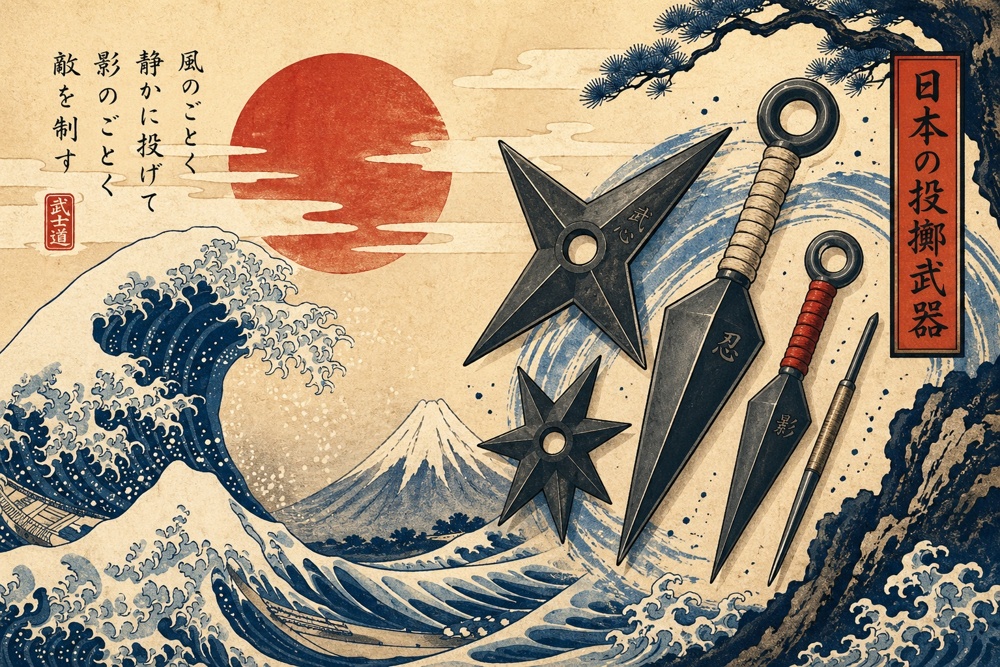
When most people picture a samurai, they picture a katana. It is the iconic image — a warrior with a long curved sword, perfectly balanced and supremely deadly. But the samurai were nothing if not practical, and the reality of feudal Japanese combat demanded a far broader arsenal. Among their lesser-known but highly effective tools were a range of throwing weapons: concealable, versatile, and often deadly at close range.
More Than a Sword
Shuriken functioned as supplementary weapons to the sword or to other weapons in a samurai’s arsenal, although they often had an important tactical effect in battle. This is the key thing to understand about samurai throwing weapons — they were not primary weapons. They were tactical tools, used to create openings, distract opponents, or buy time before closing to sword range. Shuriken were usually used before or during the drawing of the sword.
The Earliest Throwing Weapons: Tetsu-Tsubute
Before the shuriken as we know it existed, Japanese warriors were already throwing things. With the exception of primitive stone throwing, the earliest form of hidden throwing weapons in Japan were the tetsu-tsubute. These were iron balls or discs of various shapes, with a diameter of roughly 3 to 4 centimetres. They were impact weapons that could easily be concealed in the hand. Simple and brutal, these were the forerunners of the more refined throwing weapons to come.
Shuriken: The Weapon Misunderstood by History
The word shuriken is composed of three Japanese characters: “shu” (hand), “ri” (release), and “ken” (blade), roughly translating to “sword hidden in the hand.”
There are two main types of shuriken. The first is the bo-shuriken — a straight, spike-like weapon. A bo-shuriken is a throwing weapon consisting of a straight iron or steel spike, usually four-sided but sometimes round or octagonal in cross-section, ranging from 12 to 21 centimetres in length. Bo-shuriken were constructed from a wide variety of everyday items and came in many shapes and sizes — nail form, needle form, knife form, spear form, and pine-needle form, among others.
The second type is the hira-shuriken, which is closer to what most people imagine. Hira-shuriken are constructed from thin, flat plates of metal derived from a variety of sources including coins, carpentry tools, spools, and nail removers. They often have a hole in the centre, which had aerodynamic and weighting effects that aided the flight of the blade.
Despite being endlessly depicted in film and television as a ninja weapon, shuriken were more commonly carried by samurai warriors of the Tokugawa era. Used in conjunction with primary weapons such as the sword, shuriken allowed a warrior to startle his opponent, close the gap, or retreat from a dangerous interaction.
Shuriken targets were primarily the more exposed parts of the body: the eyes, face, hands, or feet. Despite low mass, they were capable of dealing lethal blows at short ranges. Beyond direct combat, shuriken could be embedded in the ground to injure those who stepped on them, wrapped in a fuse and ignited to cause fire, or coated with poison.
The art of throwing shuriken was known as shurikenjutsu, and it was taught seriously. Learning to wield the shuriken was taught at most martial arts schools, where students learned how to use the weapon to target the more exposed parts of their opponents’ bodies. The earliest-known reference to a school teaching shurikenjutsu is Ganritsu Ryu, active during the 17th century.
The Uchine: The Throwing Arrow
One of the most unusual throwing weapons in the samurai toolkit is the uchine — a hand-thrown arrow. The uchine resembled a short hand-spear with fletchings added to the tail. It was related conceptually to the shuriken but operated on a different principle entirely.
Originating as a weapon of last resort for archers whose bowstrings had broken, the uchine evolved into a close-quarters combat weapon as well as a self-defence weapon when travelling.
Its most specific use came during the Edo period. Once the Edo period started in 1600, there were no wars to fight, and high-ranking samurai started travelling the country in palanquins. Inside the palanquin it is cramped and nearly impossible to draw a sword should one be attacked. This is where the uchine shines — by throwing it at attackers, it gives the samurai riding in the palanquin one split second to actually draw his sword and defend himself.
Most of the earliest manuals on archery that mention the uchine describe its use as being “used like a shuriken” — thrown at opponents, not as a killing blow but perhaps more as a distracting weapon. The uchine could also be held and used as a short stabbing weapon when no throwing was possible.
Many of the surviving examples were very high-quality weapons, passed down through generations, with steel heads that were forged and folded like the Japanese blades. Despite this craftsmanship, the uchine is a largely forgotten weapon today — there are no known surviving martial arts schools that practise with it.
The Kunai: Not What You Think
If the shuriken is misunderstood, the kunai is perhaps even more so. Popular culture — especially anime and film — has turned it into a sleek throwing blade. The real story is more grounded.
A kunai is a Japanese multipurpose tool thought to be originally derived from the masonry trowel. It normally had a leaf-shaped blade ranging from 20 to 30 centimetres in length and a handle with a ring on the pommel for attaching a rope.
The kunai was used by common folk as a multi-purpose gardening tool and by workers of stone and masonry. The blade was soft iron and unsharpened because the edges were used to smash plaster and wood, to dig holes and to pry.
So how did it become a weapon? Since kunai were cheaply produced tools of proper size and weight and could be easily sharpened, they were readily available to be converted into simple weapons for covert uses. The ring on the pommel, originally for hanging the tool up or attaching a carrying cord, took on new tactical uses — the same cord could serve as a retrieval line when throwing the kunai, or as a climbing aid.
Crucially, the kunai is primarily a thrusting and stabbing implement that is sometimes thrown — not a dedicated throwing weapon. As a weapon it is larger and heavier than a shuriken, and with the grip could be used in hand-to-hand combat more readily than a shuriken.
Throwing Blades and Improvised Weapons
The samurai tradition was also one of resourcefulness. The father of the shuriken is considered to be the “uchimono” — the practice of throwing larger blades, such as the iron tanto or a short sword. The legendary Miyamoto Musashi is said to have won a duel by throwing his short sword at his opponent, killing him.
Beyond dedicated weapons, other items such as hairpins, utility knives, and chopsticks were thrown in the same way as bo-shuriken, although they were not associated with any particular school of shurikenjutsu. In a tradition that valued adaptability, almost any object at hand could become a weapon.
The Legacy of Shurikenjutsu
The art did not die with the samurai era. Following the samurai era, authorities such as Naruse Kanji (1888–1948), Fujita Seiko (1899–1966), and Saito Satoshi (1922–2014) continued to teach shurikenjutsu and published books to educate and preserve the ancient tradition.
Today, throwing weapons remain part of martial arts study and historical scholarship, even if the battlefield context is long gone. What they reveal about the samurai is important: these were not warriors obsessed with a single weapon, but complete fighters who understood that in combat, every tool had its place.
Sources
- Wikipedia: Shuriken — en.wikipedia.org/wiki/Shuriken
- Wikipedia: Kunai — en.wikipedia.org/wiki/Kunai
- Wikipedia: Shurikenjutsu — en.wikipedia.org/wiki/Shurikenjutsu
- Negishi Ryu Shurikenjutsu Headquarters — honbu.org/tradition
- Knife Depot Blog: The Complete History of the Shuriken — blog.knife-depot.com
- Martial Journal: Weapon of the Month Club — Uchine — martialjournal.com
- Art Publika Magazine: Your Short But Fascinating History of the Ninja Star — artpublikamag.com
- Weapons of Ancient Japan — weaponsofancientjapan.weebly.com
- Fujita Seiko & Sakai Shigeki, Uchine: Japanese Throwing Arrow, trans. Eric Shahan (2018)
- Mol, Serge. Classical Weaponry of Japan: Special Weapons and Tactics of the Martial Arts (2003)