Maija Soderholm: The Swordswoman Who Teaches You to Lie
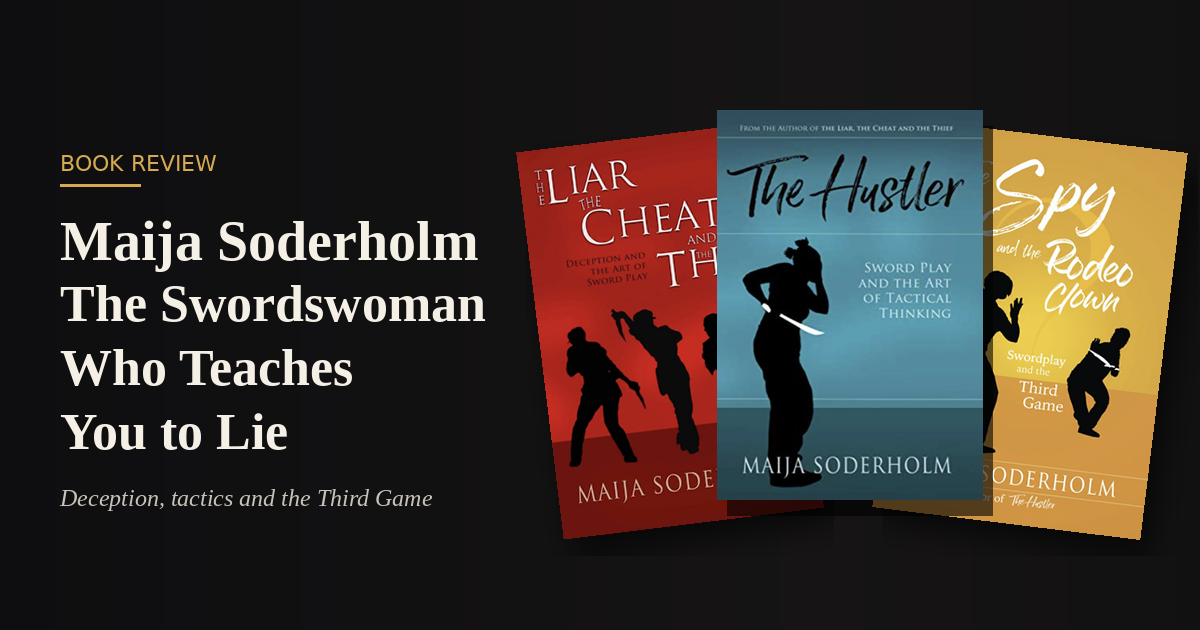
Most sword books teach you what to do. Maija Soderholm’s books teach you how to make your opponent do what you want. Across three short, sharp volumes she has built one of the most original bodies of work on swordplay written in the last decade. It deals less with technique and more with the thinking, deception and psychology that sit underneath it.
She is also one of the few women writing seriously about sword tactics. If you train with a blade, whatever the tradition, her books deserve a place on your shelf.
Disclosure: the book links in this article are Amazon affiliate links. If you buy through them we may earn a small commission, at no extra cost to you.
Who is Maija Soderholm?
Maija was born in London to Finnish parents and grew up in England before moving to the United States. She now lives in Oakland, California. As a child she fenced, and she later trained in the Chinese internal arts of Xing Yi and Bagua.
The turning point came in 2000, when she began training privately with the Filipino master Sonny Umpad. She stayed with him until his death in 2006, at the age of 58. Umpad was a famously reclusive eskrimador, regarded by many as one of the finest sword masters of his generation. He emphasised fight intelligence: when lethal weapons are in play, fighting your opponent’s mind matters as much as fighting their body.
Maija is a recognised lineage holder of his system, Visayan Style Corto Kadena and Larga Mano Eskrima. It is an art of unarmoured, unshielded sword fighting. She brings an unusual mix to it: a love of maths and art, and a degree in structural engineering. She also designs knives through her company, SoMiCo Knives.
Random Flow: the engine behind the books
All three books grow out of Umpad’s signature training method, Random Flow. There are no set patterns and no choreographed drills. Partners keep moving, and the aim is to slip a technique into the flow of play rather than simply to “win”. The one basic rule is not to get hit, which gives every movement a reason. Umpad drew partly on partner dancing, where touch tells you what is coming next.
Maija describes Random Flow as filling the gap between learning techniques and free sparring. It trains decision-making, timing and the reasons behind an action from day one. Many HEMA clubs struggle with exactly that gap.
Book One: The Liar, the Cheat and the Thief
Deception and the Art of Sword Play (2014) · Buy on Amazon
Maija wrote her first book to carry Sonny Umpad’s ideas forward. It is a book about tactical thinking, with background, drills and a detailed treatment of fakes and baits.
Her distinction between the two is worth the price on its own. A fake is a feint that only works if it convinces the opponent they really can be hit. A bait is an apparent opening that invites them to strike. Both are lies told with the body, and the book teaches you to tell them well and to spot them when they are told to you.
Although it comes from Filipino martial arts, the book has found readers among HEMA and Chinese martial arts practitioners. That makes sense: deception is universal to swordplay, whatever the weapon.
Book Two: The Hustler
Sword Play and the Art of Tactical Thinking (2019) · Buy on Amazon
The Hustler grew out of talks Maija had prepared. It takes its name from Umpad’s love of hustle dancing. It goes after common misconceptions in martial arts, particularly the habit of accepting traded hits, and the way many fighters treat mutual injury as a kind of victory.
Its central image will stay with you. The skilled fighter should be like a pickpocket: get in, do the job and leave before anyone notices. Real fights are usually lose/lose, so the real goal is to go home unhurt. Maija frames tactics as turning disadvantage into a weapon and using your opponent’s assumptions against them. She also points out that every attack opens you up, which hands the other person an opportunity.
For anyone who has watched a HEMA tournament descend into double hits, this book is overdue reading.
Book Three: The Spy and the Rodeo Clown
Sword Play and the Third Game (2023) · Buy on Amazon
In a 2020 interview Maija said she had no plans for a third book. She felt she had said what she needed to say. Happily, she changed her mind.
The Spy and the Rodeo Clown introduces a new idea: the Third Game. It is a training method that connects the physical side of fighting to the psychological. It underpins the ability not only to read an opponent, but also to write one, shaping what they believe and therefore what they do. One reader describes it as learning to get inside the opponent’s OODA loop (observe, orient, decide, act) and create openings from there.
It is the most ambitious of the three books and the natural end point of the series. The first two explored Random Flow and the psychology of the fight. This one shows how to turn that understanding into openings you create on purpose. It has been very well received by readers.
Why these books matter
There are plenty of books on how to hold a sword, and plenty of translations of historical manuals. There are far fewer on how to think in a sword fight, and fewer still by women. Maija Soderholm’s trilogy fills both gaps.
The books are short, readable and practical, and full of drills you can take straight to training. They are rooted in Filipino eskrima, but they speak just as clearly to longsword fencers, sabreurs and anyone else who faces a sharp edge, real or simulated. They also preserve the teaching of Sonny Umpad, a master who never sought fame, through one of the students he trusted to carry his work on.
If you have ever been out-thought rather than out-fought, start with The Liar, the Cheat and the Thief and read all three in order.
The books
- The Liar, the Cheat and the Thief: Deception and the Art of Sword Play (2014)
- The Hustler: Sword Play and the Art of Tactical Thinking (2019)
- The Spy and the Rodeo Clown: Sword Play and the Third Game (2023)
Train with us in Canterbury
Maija’s books are about the thinking behind the sword. At Canterbury Medieval Combat we put that thinking into practice. We teach German longsword, messer and dagger from the historical manuscripts, trained as a practical, applied martial art.
If you’re a woman who wants to pick up a sword, our Monday Ladies class (6–7pm) is a welcoming place to start. Mixed longsword classes run on Mondays and Thursdays (7–9pm), and Langes Messer runs on Thursdays (6–7pm). Beginners are always welcome.
Book a class and find out how much fun it is to out-think your opponent.
< BACK