Book Review: Armies of Arthurian Britain by Gabriele Esposito
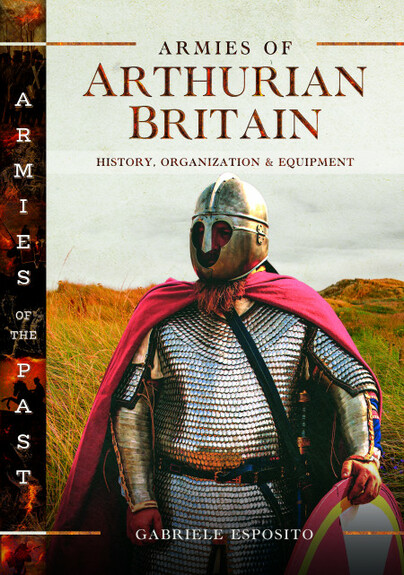
Gabriele Esposito’s Armies of Arthurian Britain is a colourful, accessible and highly detailed guide to the warriors who fought for control of Britain after the end of Roman rule. Covering the period from the decline of the Western Roman Empire to the establishment of the Anglo-Saxon kingdoms, the book brings together military history, weapons, organisation and living-history reconstruction to illuminate a famously uncertain age.
One of the book’s greatest strengths is its broad scope. Esposito does not focus only on the possible historical basis for King Arthur. Instead, he explains the wider military world in which an Arthur-like leader may have operated. Readers are introduced to late Roman soldiers, Romano-British warbands, Picts, Scots, Saxons, Angles and Jutes. This creates a much fuller picture of Britain as a contested landscape filled with rival rulers, migrating peoples and competing military traditions.
The chapters examining equipment and organisation are especially interesting. Esposito shows how the Romano-British forces inherited elements of the late Roman system while also adopting older Celtic practices. Heavy cavalry, spear-armed infantry, archers and skirmishers all had roles to play. The Saxons, meanwhile, brought their own traditions of infantry warfare, seaborne raiding and close combat. The sections on Pictish and Gaelic warfare also add welcome variety, describing tribal levies, professional retainers, javelin-armed skirmishers and the importance of mobility.
A line from the introduction neatly captures the book’s martial focus:
“The Saxons, Angles and Jutes who invaded Britain from the mid-fifth century had their own distinct Germanic military traditions, which they imported to the British Isles at the point of their swords.”
The visual content is another major attraction. The book is packed with photographs of historical re-enactors, colour plates and reconstructed equipment. Images of Romano-British warriors in chainmail, Pictish fighters carrying compact shields, and Saxon warriors armed with spear, sword and axe help turn technical descriptions into something immediately understandable.
Esposito also handles the Arthurian question sensibly. Rather than presenting legend as fact, he considers Ambrosius Aurelianus and the Battle of Badon within the military and political realities of sub-Roman Britain.
Overall, Armies of Arthurian Britain is an enjoyable and informative introduction to a complex period. It will appeal particularly to readers interested in historical combat, weapons, re-enactment, late Roman warfare and the military world behind the Arthurian legends.
< BACK