The Way of the Bow: Samurai Battlefield Archery and Kyujutsu
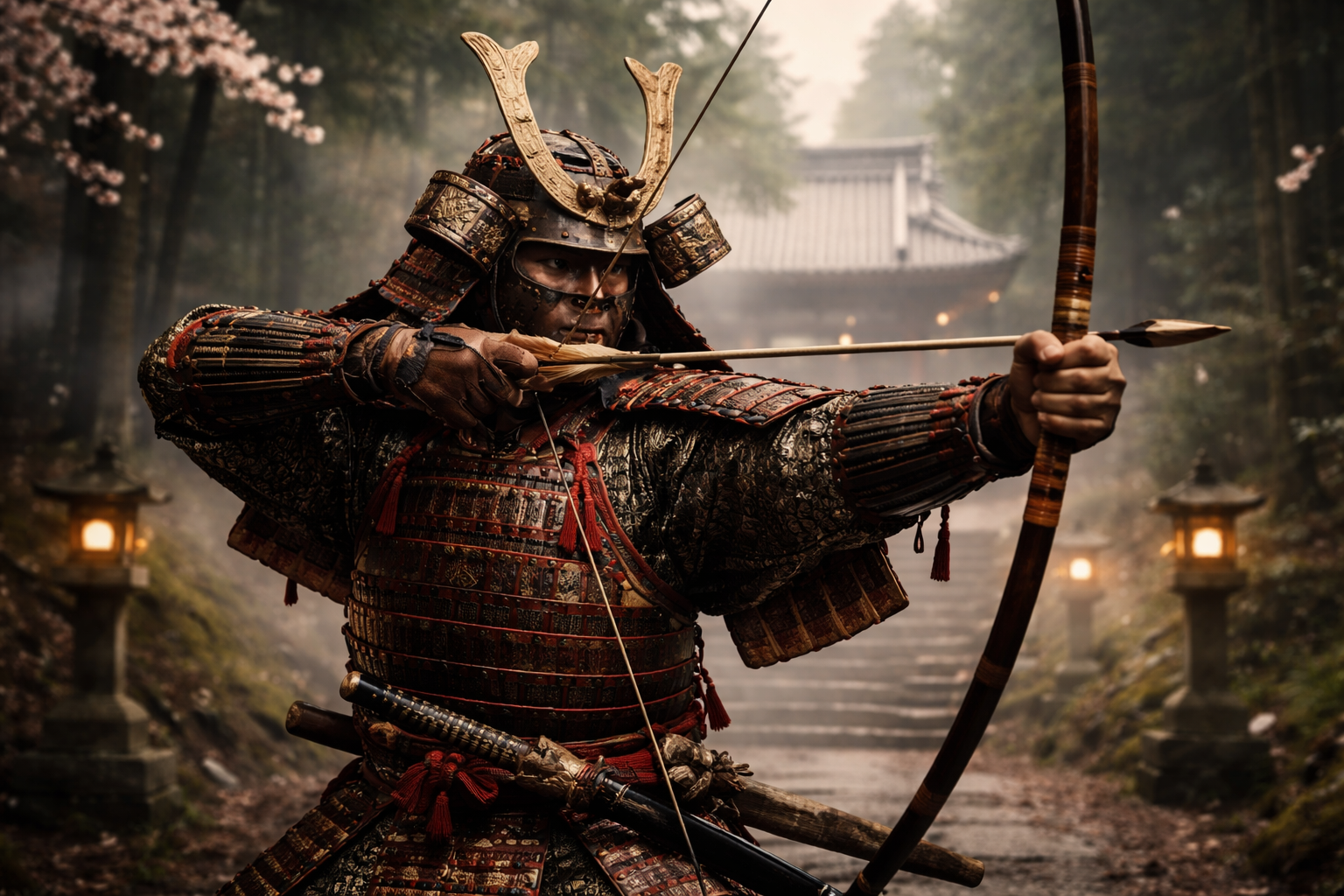
The image of a samurai warrior conjures visions of the katana, that iconic curved blade that came to symbolise the martial prowess of medieval Japan. Yet long before the sword became the primary weapon of choice, the bow—yumi—reigned supreme on the Japanese battlefield. Kyujutsu, the martial art of Japanese archery, was not merely a combat technique but a fundamental discipline that shaped samurai culture, philosophy, and identity for centuries. Understanding kyujutsu is essential to comprehending the true nature of the samurai warrior and the evolution of warfare in feudal Japan.
Historical Development
Early Archery Traditions
The history of archery in Japan extends back millennia, with evidence suggesting that bows were used for hunting and warfare as early as the Yayoi period (300 BCE – 300 CE). However, it was during the Heian period (794–1185) that archery became formalised as a crucial element of samurai training. The mounted archer, known as a yumiarite or kyusha, became the backbone of military forces during this era.
The transition from the Heian to the Kamakura period (1185–1333) saw significant changes in Japanese warfare. The rise of the samurai class coincided with the development of more refined archery techniques. Early samurai were expected to be skilled horsemen and archers long before they were swordsmen, and this tradition remained important throughout the feudal period.
The Golden Age of Battlefield Archery
The Sengoku period (1467–1615), an era of prolonged civil war and fragmentation, represented the zenith of kyujutsu’s battlefield importance. During this period, large-scale battles featuring hundreds or even thousands of soldiers saw archery as the primary means of engaging the enemy at distance. Archers, organised into units called yumigumi, would unleash volleys of arrows to soften enemy formations before closer combat ensued.
The effectiveness of massed archery became so apparent that military commanders prioritised recruiting skilled archers. Entire villages were sometimes conscripted based on their reputation for producing excellent bowmen, and regional variations in archery technique emerged across different provinces.
The Bow and Its Components
The Yumi: An Asymmetrical Masterpiece
The Japanese longbow, or yumi, stands apart from its European counterparts in both design and construction. Rather than being symmetrical, the yumi features a distinctive asymmetrical design, with the grip positioned much lower on the bow—typically about one-third of the way up from the bottom. This unusual construction allowed archers to draw the bowstring to their ear or cheek whilst maintaining a stable stance, even when mounted on horseback.
The yumi was traditionally constructed from bamboo and wood, most commonly combining a wooden core with bamboo backing. The most prized bows were made from Korean bamboo, which was considered superior in flexibility and durability. A fully functional yumi could measure between 2 metres and 2.4 metres in length, making it one of the longest bows in the world.
The craftsmanship required to construct a quality bow was extraordinary. Bowyers, known as yumishi, were highly respected artisans who spent years perfecting their trade. The process involved careful selection of materials, precise shaping, and treatment with various oils and finishes to ensure durability and consistency.
Arrows and Quivers
Japanese arrows, called ya, were typically fashioned from bamboo or wood and fletched with feathers from various birds, most commonly eagle or hawk feathers. Arrow lengths varied considerably—typically ranging from 75 centimetres to over 90 centimetres—and were often customised to suit individual archers and specific purposes.
Arrows destined for warfare often featured distinctive broad-heads or barbed tips designed to maximise damage. Some arrows, called kabura-ya or “whistling arrows,” featured hollowed bulbs that produced a distinctive sound in flight. These were particularly valued for their psychological impact on the enemy, as the eerie whistling could unsettle opposing forces and signal the commencement of battle.
Archers typically carried arrows in a quiver known as a yazutsu, though in large-scale battles, additional arrows were often stored nearby in bundles for rapid resupply. A skilled archer could loose multiple arrows in quick succession, and having ready access to fresh ammunition was crucial during prolonged engagements.
Kyujutsu Techniques and Training
Mounted Archery—Yabusame
One of the most distinctive forms of samurai archery was yabusame, or mounted archery. This technique, perfected during the Heian and Kamakura periods, required extraordinary skill and years of dedicated training. A yabusame archer, mounted on a galloping horse, would attempt to strike moving targets whilst maintaining control of their steed using only their knees and seat.
The technical demands of yabusame were immense. The archer needed to:
- Master horsemanship to an elite level
- Draw the bowstring smoothly whilst mounted and in motion
- Maintain aim despite the constant movement and vibration
- Release the arrow with precise timing
- Manage their breathing and composure
Yabusame remains popular in modern Japan as a ceremonial and competitive practice, particularly in the Kamakura region where the technique originated. Several shrines continue to host annual yabusame competitions that attract large crowds of spectators.
Infantry Archery—Kyujutsu Proper
For foot soldiers, kyujutsu training emphasised rapid, accurate shooting from static or slowly moving positions. Infantry archers worked in coordinated units, receiving commands to loose volleys simultaneously. This created a devastating rain of arrows that could break up enemy formations or provide covering fire for advancing troops.
Infantry archers typically employed a somewhat different technique from their mounted counterparts. Standing on solid ground allowed for more powerful draws and greater consistency. The seiza posture—kneeling on the heels—was sometimes used for stability, particularly when firing at distant targets or when positioned on elevated terrain.
Fundamental Stances and Methods
Kyujutsu training began with mastering fundamental stances and the proper method of drawing and releasing arrows. The basic stance, called kashira, required the archer to stand with feet shoulder-width apart, with the left side of the body turned toward the target. This positioning allowed for a full draw whilst maintaining balance and stability.
The draw itself was executed using a technique called tsumeai, which emphasised pulling the bowstring with the back muscles rather than the arm muscles alone. This approach generated greater power and, importantly, allowed for greater consistency and repetition without fatigue.
The release, known as hanare, was executed by simply relaxing the hand holding the bowstring, allowing the fingers to open naturally. Premature or inconsistent release was a common source of error, and considerable time was spent training proper release technique.
Psychological and Philosophical Dimensions
Mind and Spirit in Combat
Like other samurai martial arts, kyujutsu was deeply connected to Zen Buddhism and the philosophy of mushin—literally “no mind.” This concept emphasised performing actions without conscious deliberation, allowing the archer to act with perfect spontaneity and freedom. Archery practice became a form of meditation, with the goal of achieving a state of perfect mental clarity and unity with the bow and arrow.
Many samurai saw archery not merely as a practical skill but as a path to self-realisation and spiritual development. The focus required for accurate shooting, the discipline demanded by consistent practice, and the acceptance of both success and failure all contributed to the development of character and spiritual growth.
Kyujutsu in Samurai Culture
Archery occupied a unique position in samurai culture. Whilst the sword became the symbol of samurai identity and honour, archery remained deeply embedded in their practical training and cultural practices. Many samurai families maintained archery ranges and practised regularly throughout their lives, regardless of whether they were actively engaged in military service.
The skill remained so important that even as firearms gradually replaced traditional weapons during the late Edo period, archery continued to be practised and valued. The discipline and mental training provided by kyujutsu were seen as beneficial regardless of their practical utility in contemporary warfare.
The Decline and Legacy
The Rise of Firearms
The introduction of firearms to Japan in the mid-16th century, brought by Portuguese traders, gradually transformed warfare. By the end of the Sengoku period and throughout the Edo period (1603–1868), muskets became the predominant ranged weapon. However, this transition was gradual, and archery remained relevant for several centuries, with many armies maintaining specialist archer units well into the 17th century.
The decline of kyujutsu as a battlefield skill did not mean its disappearance. Instead, it was preserved and refined as a martial art and cultural practice. During the peaceful Edo period, many samurai turned to archery as a means of maintaining their martial identity and developing spiritual discipline.
Modern Kyujutsu and Kyudo
Today, kyujutsu has been largely superseded by kyudo, a modern martial art and sport that preserves traditional archery techniques whilst emphasising spiritual development and personal improvement. Kyudo competitions are held internationally, and the practice has gained significant following both within Japan and abroad.
Kyudo practitioners focus on the philosophical and technical aspects of archery without the practical concern for combat effectiveness. The fundamental techniques remain largely unchanged from historical kyujutsu, preserving knowledge that might otherwise have been lost. Many of the principles of stance, draw, and release used in modern kyudo trace directly back to samurai battlefield archery.
Notable Historical Figures
The Legendary Archers
Japanese history records numerous exceptionally skilled archers whose deeds became legendary. Minamoto no Tametomo, a 12th-century warrior, was said to possess such strength that he could fire arrows of extraordinary distance and power. His archery prowess became so renowned that he was known by the epithet Chinzei Hachiro Tametomo—”the second-greatest archer in the land.”
Nasu no Yoichi, another legendary figure from the same period, is famous for an incident during the Genpei War in which he supposedly fired an arrow from his horse whilst riding at full gallop to strike a fan held aloft by an enemy warrior. This feat, whether historically accurate or embellished through retelling, exemplifies the ideal of the skilled mounted archer in samurai culture.
Conclusion
Kyujutsu, the martial art of samurai battlefield archery, represents far more than a simple weapons technique. It embodies the practical, philosophical, and spiritual dimensions of samurai culture, serving as a bridge between the physical demands of warfare and the inner development of the individual warrior.
The bow, in samurai hands, was an instrument of both practical and symbolic significance. It required discipline, focus, and dedication to master, and the pursuit of archery excellence became inseparable from the pursuit of personal development and spiritual enlightenment.
Though the age of samurai warfare has long passed, and firearms have rendered traditional archery obsolete as a practical weapon, the legacy of kyujutsu endures. In the modern practice of kyudo, the fundamental techniques and philosophical principles established by generations of samurai archers continue to guide practitioners towards excellence, discipline, and self-realisation.
The samurai archer, drawing his bow on a distant battlefield centuries ago, reminds us that the pursuit of mastery—whether in combat or in life—demands not merely technical skill but unwavering commitment to continuous improvement and spiritual growth. In this sense, kyujutsu remains as relevant today as it ever was.
References and Further Reading
- The Samurai: A Military History – Stephen Turnbull
- Samurai Warfare – Thomas D. Conlan –
- Zen in the art of Archery – Eugene Herrigel
- Samurai Armies of the Late Sengoku Period: Volume I: Anatomy of a Samurai Army in the 16th and 17th Centuries – Till Weber