Book Review: Gladiators in the Greek World: How a Roman Blood Sport Took Ancient Greece by Storm
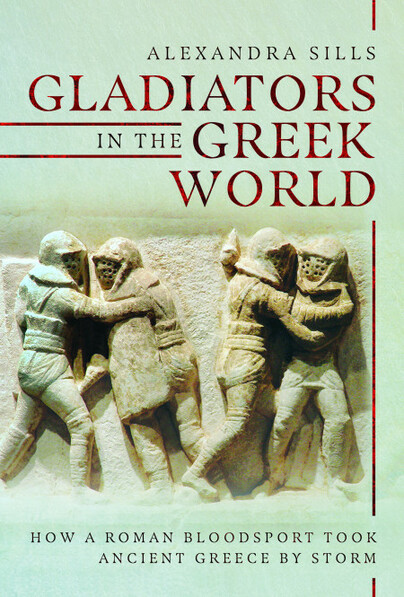
Alexandra Sills’ Gladiators in the Greek World is a fascinating and original study that challenges one of the biggest assumptions about the ancient world—that gladiatorial combat was purely a Roman phenomenon. Instead, Sills demonstrates that the Greek-speaking eastern Mediterranean embraced gladiatorial spectacle in its own distinctive way, blending Roman traditions with local customs and creating a compelling history that combines archaeology, literature and ancient inscriptions into a remarkably accessible read.
What makes this book particularly enjoyable is the author’s ability to balance detailed research with an engaging writing style. Rather than simply cataloguing gladiatorial games across the Greek world, Sills asks why Greek communities embraced these spectacles and how they adapted them to fit their own culture. The result is a book that constantly challenges expectations and offers fresh perspectives.
One of the standout chapters is “Life at the Ludus.” Instead of focusing solely on the violence of the arena, Sills explores the everyday lives of gladiators as professional athletes. She explains how they trained, ate, lived and recovered from injury, dispelling many of the myths created by modern films. Ancient writers even recorded some unusual medical practices. As Pliny the Elder observed, “Your hearth should be your medicine chest. Drink lye made from its ashes… One can see how gladiators after a combat are helped by drinking this.” Quoted by Sills, it is just one of many fascinating details that bring the world of the gladiator to life while highlighting the practical realities of surviving in the arena.
The breadth of research is equally impressive. From amphitheatres and stadiums to funerary inscriptions, mosaics and archaeological discoveries, Sills draws on an extraordinary range of evidence to reconstruct the lives of gladiators in the Greek East. The illustrations and case studies add further depth, making the history easy to follow without sacrificing detail.
Perhaps the book’s greatest achievement is showing that gladiatorial combat was never simply a Roman export. Instead, it became something that Greek communities adapted, celebrated and remembered in their own way. Readers come away with a much richer understanding of both gladiatorial culture and the wider ancient Mediterranean.
Whether your interest lies in Roman history, ancient Greece, archaeology or martial culture, Gladiators in the Greek World is an engaging and rewarding read. Informative without ever becoming heavy, it is a book that will leave readers looking at one of history’s most famous spectacles in a completely new light. You can follow Alexandra on Facebook
< BACK