The Art of Chinese Hidden Weapons: Feidao and Feijian Through History
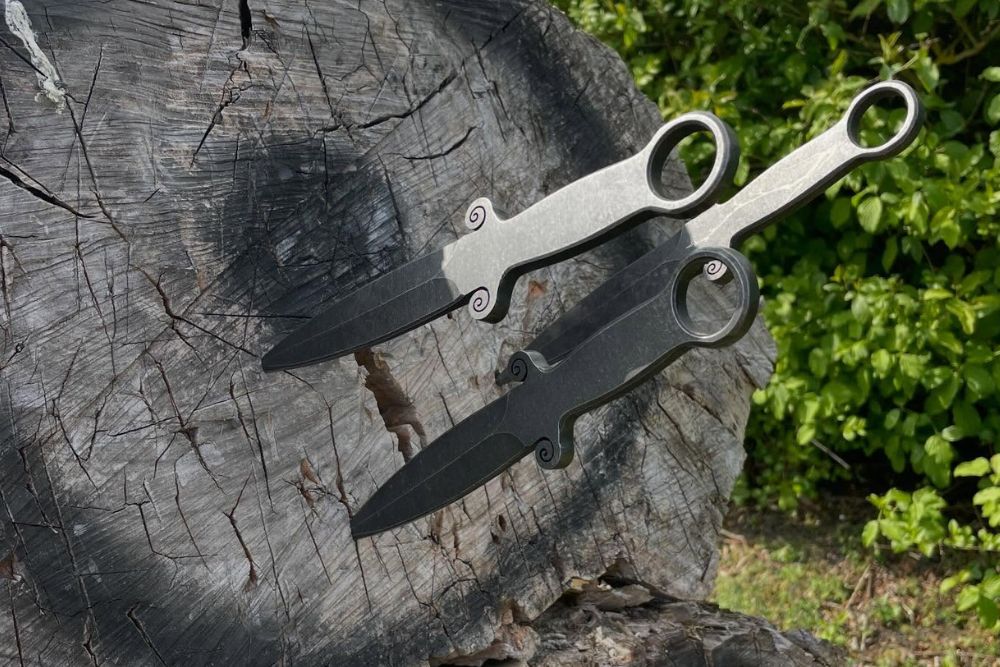
Hidden weapons have long captured the imagination, from ancient battlefields to modern martial arts films. Yet beneath the romantic legends lies a sophisticated martial tradition grounded in real technique, rigorous training, and documented history. This article explores two of China’s most notable hidden weapons: the Feidao (飞刀), or flying knife, and the Feijian (飞剑), or flying dagger. Sourced from nearly century-old Republican-era Chinese texts – The Secret Techniques of Practicing Hidden Weapons and The Complete Transmission of FEIBIAO, FEIDAO, and FEIJIAN: Hidden Weapons Anthology – we trace these weapons from their legendary origins to their practical applications.
NOTE: We are accepting UK preorders for our range of Sword Tribe Asian throwing Knives. Visit Sword Tribe for more details.
Part One: The Feidao (Flying Knife)
History and Design
The Feidao is a refined throwing weapon with a sophisticated design reflecting centuries of martial innovation. The traditional double-edged variety, commonly known as the “Willow Leaf Throwing Knife,” derives its name from its distinctive silhouette.
Physical Specifications:
Blade: Approximately 6 inches long (19.8 cm), narrower at the top and wider toward the base, resembling a willow leaf
Handle: About 1.7 inches long (5.6 cm)
Guard: Positioned between blade and handle, slightly wider than the handle itself
Construction: Double-edged steel, thin as paper, with a raised ridge running along the center of each side
Weight Distribution: Blade: slightly over three taels; Iron handle: about four taels; Guard: about two taels; Total weight: approximately ten taels (320 g)
The blade’s tip is extremely sharp, and the overall design mirrors that of a sword, with the thickest part of the ridge measuring just over two millimeters. At the end of the handle are red and green silk ribbons, each about two inches long—these serve a crucial aerodynamic function, creating wind resistance during flight to aid in aiming, much like the tails on a throwing dart.
Carrying and Storage
The Feidao required specialized carrying methods distinct from those used for throwing darts. While darts are worn at the waist, the knife scabbard is worn across the back. Right-handed users sling it from the left shoulder across to the spine, while left-handed users wear it from the right shoulder to the spine.
A full carrying set consisted of twelve knives stored in a single scabbard, ideally made from sharkskin. The scabbard is divided into upper and lower rows of six knives each, with tips pointing downward and handles exposed for quick access—crucial for rapid deployment in combat.
Combat Applications
The Feidao’s killing power lies primarily in its sharp point. While the dual edges exist, they have relatively limited use in a throw. An opponent who manages to dodge the tip might still be cut, but fully utilizing both edges for chopping or slashing in close combat requires exceptional skill, typically more than ten years of dedicated training.
The weapon’s weight and size were adjustable based on the practitioner’s preferences and needs. However, practitioners had to balance competing concerns: weapons that were too light and small proved difficult to cause injury, while those that were too heavy and large became burdensome to carry. The optimal specification was balanced and medium-weight.
Training the Willow Leaf Knife
Training in the Feidao differs entirely from training with throwing darts or arrows and is considerably more difficult. The throwing motion itself is singular but highly specialised.
The Yin Shou Motion:
Power is delivered through only one throwing technique called yin shou (inward hand), a downward wrist-snap motion. Unlike darts, practitioners cannot throw sideways or upward. The knife is held by the handle and snapped forward and downward, relying solely on wrist force rather than a pushing motion like shooting an arrow.
Because it’s driven purely by this snap, the knife follows a semi-circular path – a parabolic arc. This is crucial to understanding the technique: when aiming, the tip must be aimed several inches above the target so it drops into it from its highest point.
Training Progression:
The training regimen was systematic and demanding:
1. Initial Stage (1 Zhang Distance): Stand approximately 3.3 meters from the target. Draw a knife from the scabbard, aim with the tip about one inch higher than the bullseye, and throw. Practitioners would throw all twelve knives in sequence, analyzing misses (too high, too low, too left, too right) and adjusting. Morning and evening practice sessions with set durations became routine.
2. Distance Training: Once reliable accuracy was achieved at one zhang, practitioners would move back several feet and repeat. The critical principle: the farther the distance, the higher the tip must be aimed—simply applying the law of the parabola.
3. Precision at Range: When practitioners could hit accurately from one hundred paces (approximately 165 meters), the target size would be reduced. Training continued until they could strike a spot less than an inch in diameter with perfect consistency.
4. Vital Point Training: The next phase introduced life-size human targets drawn on wooden boards. One featured a front view with full facial features; another showed the back view with small circles marking vital points behind the ears and elsewhere. From one hundred paces, practitioners first trained to hit both eyes, then the ears, nose, and specific facial points (such as tian ting, yin tang, and the temples). After mastering the front view, they would practice the same vital points on the back view until they could strike any chosen point at will.
5. Mastery: At this stage, the art of throwing knives was considered complete. From start to finish, this training regimen typically required at least three years of dedicated practice.
The final refinement came through personal experience. With extended practice, skill became second nature, and countless technique variations emerged naturally, allowing practitioners to adapt to different situations and targets.
Part Two: The Feijian (Flying Dagger)
Legend and Early History
While tales of flying daggers often venture into the fantastical with claims of swords forged through mystical breathing techniques or pills transformed into blades – the Feijian represents a genuine, learnable martial art. Its origins stretch back centuries.
The Tang Dynasty Connection:
Historical records place the flying dagger in the Tang dynasty, specifically mentioning a figure named Ye Fashan (also known as Ye Daoyuan), a famed hermit living in the Maoyou Mountains near Songyang. A master of Yin-Yang divination and incantations, Ye Fashan gained such renown that Emperor Xuanzong once summoned him to perform mystical rituals.
According to the Kaitian Chuanxin Ji, Ye Fashan demonstrated his martial prowess at Zhenyuan Temple when an uninvited guest—a man claiming to be Qu Xiucai—arrived at an official gathering. The handsome and eloquent stranger made an impression on the assembled officials. Without hesitation, Ye Fashan picked up a small sword and hurled it, striking the intruder down on the spot. The man revealed himself to be nothing more than a wine gourd concealing fine liquor – a test of Ye’s abilities.
Crucially, historical records clearly state that Ye used his hand to throw a tangible small sword, not an immaterial weapon summoned by breath. This aligns precisely with what we now call flying swords in hidden weaponry. The flying sword method can thus be traced to at least the Tang dynasty, with Ye Fashan likely responsible for popularizing it among the martial enthusiasts of the capital.
Subsequent Development:
After the Tang dynasty, flying swords became an established fixture in hidden weapons practice. During the Song dynasty, hidden weapons flourished with countless ingenious mechanical devices and contraptions that improved ease of use, accuracy, and range – including foot bows and sleeve arrows. Consequently, flying knives and daggers temporarily declined in popularity, passed down sporadically like faint threads through the generations.
The Qing Dynasty Renaissance
The real resurgence of flying sword mastery occurred during the early Qing dynasty under notable figures who elevated the technique to an art form.
Zhang Huaiwu and the Xinglong Escort Agency:
A man named Zhang Huaiwu established the Xinglong Escort Agency by imperial decree, specialising in protecting merchants and travelers. He gathered talented warriors from all directions who converged to exchange techniques – particularly those of hidden weapons, to which they devoted exceptional effort
In this environment, armed escorts (biaoshi) were expected to possess one astonishing skill. This served a dual purpose: impressing others and leaving a personal mark so that anyone encountering a particular hidden weapon would instantly recognize its wielder. This practice helped prevent trouble and ensured safe passage for the escorts’ charges. This competitive atmosphere drove extraordinary development in dart and throwing techniques.
“Swordmaster Li” and His Legacy:
Among the exceptional practitioners who emerged was a man from Hebei named Li, a disciple of Zhang’s. Li distinguished himself through extraordinary skill with flying swords. On countryside outings, he would casually throw small swords to skewer wild animals, always hitting his mark with precision.
One tale illustrates his mastery: deep in the mountains, Li’s party encountered a golden leopard. Alarmed, the group armed themselves to drive the beast away, but the animal refused to flee and charged. Li quickly hurled a sword, striking the leopard’s left eye. Roaring in pain, the beast reared upright. Li’s second sword flew immediately, piercing its belly and felling it. The onlookers were awestruck.
When Li shared his technique, he revealed that it had been passed down through seven generations in his family. His distant ancestor, a commander in the Qi Family Army, had acquired the skill from a mysterious stranger and used it to win many battles. Since then, it had been carefully preserved and never casually shared.
From that point forward, people addressed him not by name but as “Swordmaster Li.” While technically his flying sword was a type of hidden weapon rather than swordsmanship per se, the title reflected his legendary status. At the time, any escort using flying swords was presumed to be a disciple of Li, and few dared challenge them, fearing the legend of the leopard-slayer.
After Li’s death, a dozen or so of his disciples could use flying swords, but none matched his mastery. They kept to themselves, swore not to pass the technique lightly, and the number of practitioners dwindled.
Later Masters:
In the reign of the Xianfeng Emperor, a famed constable named He excelled at the art, able to hit birds and beasts within one hundred paces without fail. Thanks to this skill, he captured criminals without mishap and enjoyed a celebrated reputation for decades. In his old age, while investigating a provincial treasury robbery, He was unable to best the formidable thief in close combat. However, he severed the man’s leg with a flying sword and captured him, demonstrating once again the weapon’s lethal potential.
After He’s era, few experts in flying swords emerged. While some present-day hidden weapon practitioners claim proficiency, it remains doubtful that any possess the refined skill of Li or He. Nevertheless, with devoted study, surpassing the ancients is not impossible.
The Structure of the Flying Sword
Unlike flying darts or throwing knives, which come in numerous variations, the flying sword has only one standardized form. A short weapon featuring a double-edged, sharp-tipped blade, it is essentially a miniature version of a standard sword – identical in shape but much smaller.
Anatomy and Terminology:
Blade: The primary cutting surface, measured from base to tip
Jian Tou (剑头): The sharp triangular tip – the most crucial part of the weapon, as sword techniques emphasize thrusting over slashing
Ren (刃): The thin, sharp edges beneath the tip
Jian Ji (剑脊): The central ridge on both faces of the blade
Jian Pan (剑盘): A round handguard at the junction between blade and handle
Jian Jing (剑茎): The handle section
Tan (镡): A small ring at the pommel
Detailed Dimensions:
Total blade length: 7 cun (25.8 cm)
Tip (Jian Tou): approximately 0.5 cun (1.65 cm)
Blade proper (tip to handguard): 4.5 cun (14.85 cm)
Edge-to-edge width: approximately 0.5 cun (1.65 cm)
Ridge-to-ridge width: approximately 0.2 cun (0.66 cm)
Handguard diameter: approximately 1 cun (3.3 cm), thickness 0.2 cun (0.66 cm)
Handle length: 2 cun (6.6 cm), circumference 0.5 cun (1.65 cm)
Pommel ring circumference: less than 0.5 cun (1.65 cm)
Weight and Portability:
Each flying sword weighed between 5 liang (160 g) and 7 liang (224 g) – approximately one-seventh to one-eighth the weight of a full-size sword. This careful calibration reflects a fundamental principle of hidden weapons: portability is paramount. Too large is cumbersome; too heavy hinders throwing. The flying dagger represents the optimal balance.
Forging the Flying Sword
Forging a Feijian was an arduous, time-consuming process. Like the legendary swords of Ganjiang and Moye, it required years of repeated hammering and refining to transform crude iron into exceptional steel—capable of slicing through iron as if it were mud.
The essential process involved several critical steps:
- Material Selection: Choosing fine wrought iron as the base material
- Initial Smelting: A complete smelting cycle to refine the iron
- Soaking: Immersing the blade in a well or mountain stream for several days
- Reforging: Hammering the blade again to align its structure
- Re-soaking: Another immersion period to allow impurities to settle and be removed
- Repetition: This cycle of reforging and re-soaking repeated multiple times until all impurities were removed and the steel achieved optimal quality
The result was a blade suitable for both throwing and, if necessary, close combat use—a weapon worthy of the legendary masters who wielded it.
Conclusion: The Reality Beyond Legend
The popular imagination often divorces flying weapons from martial reality, envisioning them as instruments of pure fantasy. Yet the historical record and surviving training manuals reveal something far more grounded: sophisticated weapons developed through centuries of martial experimentation, refined through rigorous training protocols, and documented with remarkable precision.
The Feidao represents a systematized approach to knife throwing, with detailed specifications, explicit carrying methods, and a clearly defined training progression that required years of dedicated practice. The Feijian carries the prestige of historical masters whose exploits became legendary precisely because they were rooted in genuine skill and measurable results.
Both weapons share common principles: precision through repetitive practice, understanding of physics and trajectory, and the cultivation of martial mastery that transforms technique into second nature. Neither requires mystical breath control or supernatural forging; both demand the more difficult thing—discipline, dedication, and thousands of hours of practice.
For modern practitioners interested in hidden weapons, whether for historical martial arts study or contemporary throwing sports, these historical accounts offer both inspiration and instruction. The path to mastery remains unchanged: begin with fundamentals, progress through systematic training, and trust that with devoted study, one might surpass the ancients.
The art of the Feidao and Feijian endures not because of legend or fantasy, but because of the enduring human drive to perfect a craft through disciplined practice – a drive that transforms ordinary steel into instruments of precision and ordinary practitioners into masters of a martial art centuries old.
Sources
The Secret Techniques of Practicing Hidden Weapons (Republican-era Chinese text)
The Complete Transmission of FEIBIAO, FEIDAO, and FEIJIAN: Hidden Weapons Anthology (Republican-era Chinese text)
Historical records and Tang dynasty sources referenced in original texts
Special thanks to Chief Lao Qiu (酋长老秋) for providing the original source materials and related assistance.
< BACK