The Weapons of the Samurai Battlefield: 16th and 17th Century Japan
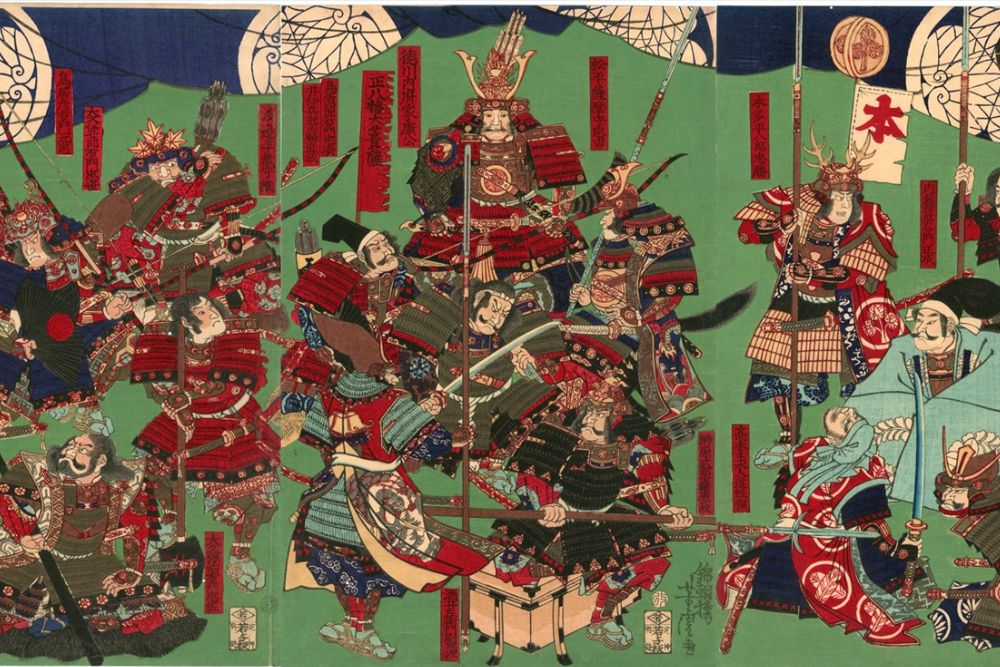
The samurai of Japan’s Sengoku period (1467–1615) and early Edo era were among the most formidably armed warriors in human history. Far from the romanticised image of a lone swordsman, the battlefield samurai was a versatile fighter equipped with a sophisticated arsenal — one that evolved rapidly in response to the chaos of near-constant civil war, and later, the transformative arrival of European firearms. This article examines the principal weapons that defined samurai warfare during these two turbulent centuries.
The Yumi — The Longbow
Before the sword became the dominant symbol of the samurai, it was the bow that defined the warrior class. The yumi, or Japanese longbow, was for centuries the weapon of prestige on the battlefield. Asymmetrical in design — with the grip positioned roughly one-third of the way up the bow rather than at the centre — the yumi was typically over two metres in length and was constructed from laminated bamboo, wood, and leather. This composite construction gave it exceptional power and flexibility, capable of launching an arrow with remarkable accuracy and penetrative force.
During the 16th century, mounted archery (yabusame) remained an important martial skill, though the nature of warfare was shifting. As armies grew larger and infantry tactics evolved, the bow increasingly became the province of foot soldiers (ashigaru) fighting in massed formations. Arrows were fitted with a variety of specialised heads — armour-piercing points, blunt heads for stunning opponents, and even whistling kaburaya heads used for signalling or psychological effect on the battlefield.
The Yari — The Spear
If the bow was the weapon of prestige, the yari (spear) was the weapon of practical dominance during the 16th century. Warlords such as Uesugi Kenshin and Oda Nobunaga recognised that massed formations of spearmen, moving in disciplined ranks, could break cavalry charges and overwhelm enemy infantry. Nobunaga famously deployed extraordinarily long spears — some exceeding six metres in length — to devastating effect at the Battle of Nagashino in 1575.
The yari came in numerous forms. The su-yari was a straight-bladed spear suited to thrusting in tight formations. The kama-yari featured cross-blades for hooking and trapping opponents or their weapons. The jumonji-yari bore a distinctive cross-shaped head, ideal for catching sword blades in close combat. For the samurai warrior, the yari offered reach and power that even the finest sword could not match in an open engagement, and its use required a very different discipline — one focused on formation and collective movement rather than individual combat.
The Naginata — The Glaive
The naginata is perhaps best described as a curved blade mounted atop a long pole, resembling a glaive or a shortened polearm sword. It had a long history in Japanese warfare before the 16th century and remained relevant throughout the period, though its use shifted considerably over time.
On the early Sengoku battlefield, the naginata was used by both mounted and foot samurai, offering the reach of a spear combined with the cutting ability of a curved blade. It was particularly effective against cavalry, as a sweeping stroke could wound or disable a horse. Over the course of the late 16th and into the 17th century, however, the naginata was gradually displaced on the battlefield by the longer and more versatile yari. Increasingly, it became associated with the training of women of samurai families, a tradition that persists in Japanese martial arts to this day. Its battlefield legacy, however, was formidable.
The Katana and Wakizashi — The Paired Swords
No weapon is more synonymous with the samurai than the katana — the long, single-edged, curved sword worn at the hip with the cutting edge facing upward. Yet its battlefield role in the 16th century is frequently misunderstood. In the thick of large-scale engagements, the katana was largely a secondary weapon, drawn only when a samurai had lost his primary arm or found himself in close-quarters combat where a spear or bow was impractical.
That said, the sword was deeply embedded in samurai identity and culture. The daisho — the paired combination of the long katana and shorter wakizashi — became a formal mark of samurai status during the Edo period following Toyotomi Hideyoshi’s 1588 Sword Hunt (Katanagari), which disarmed non-samurai classes and effectively reserved the wearing of long swords to the warrior caste alone.
The craftsmanship of the katana reached extraordinary heights during this period. Swordsmiths employed a complex process of folding and differentially tempering high-carbon steel (tamahagane), producing a blade with a hard, razor-sharp cutting edge and a more flexible spine — a combination designed to prevent both chipping and snapping. The result was a weapon of astonishing quality, and the finest blades of the period are considered among the greatest metallurgical achievements in world history.
The wakizashi, typically between 30 and 60 centimetres in length, served as a close-quarters backup weapon and was also used for the ritual suicide known as seppuku, a practice which carried profound cultural and honourable significance within the samurai code.
The Tanto — The Dagger
Shorter still than the wakizashi, the tanto was a single- or double-edged dagger carried by many samurai. In battle, it served as a last-resort weapon in the most intimate of engagements — finding gaps in armour, finishing wounded enemies, or used in the grim close-quarters of a grappling fight. It was also used in seppuku alongside or in place of the wakizashi. Some tanto were heavily reinforced for armour-piercing, while others were finely decorated objects as much as functional weapons.
The Teppo — The Arquebus
The arrival of Portuguese traders on the island of Tanegashima in 1543 introduced to Japan the tanegashima or teppo — the matchlock arquebus — and with it, a revolution in Japanese warfare that unfolded with extraordinary speed.
Japanese gunsmiths reverse-engineered and improved upon the Portuguese design with remarkable efficiency. Within decades, Japan was producing matchlock firearms in quantities that few other nations in the world could match. The arquebus fired a lead ball capable of penetrating contemporary Japanese armour at battlefield ranges, fundamentally challenging the primacy of the sword and the bow.
Oda Nobunaga grasped the tactical potential of firearms before most of his contemporaries. At the Battle of Nagashino in 1575 — one of the most significant engagements of the Sengoku period — he deployed approximately 3,000 arquebusiers in rotating volley fire behind field fortifications, shattering the cavalry charges of the Takeda clan. It was a watershed moment in Japanese military history, demonstrating that massed disciplined firepower could break even the most renowned cavalry force.
By the late 16th and early 17th centuries, larger firearms had also appeared, including artillery pieces used in sieges. The great castle-building boom of the Sengoku period was partly a response to this new reality, with thicker stone walls and more complex defensive layouts designed to absorb cannon fire. However, following the establishment of Tokugawa rule and the enforced peace of the Edo period, the government progressively restricted and then effectively suppressed firearms production — a deliberate policy to maintain social order and protect the samurai class’s monopoly on violence.
Armour and the Relationship with Weaponry
No account of samurai weapons is complete without acknowledging the intimate relationship between weapon design and armour. Samurai armour (yoroi in earlier forms, evolving into the tosei gusoku or “new armour” of the 16th century) was a sophisticated system of lacquered iron and leather plates, laced together to balance protection with mobility.
As firearms spread, armoursmiths adapted — producing tameshi gusoku, or “bullet-tested armour”, with thicker iron plates that bore deliberate dents from proof-testing with arquebus fire. The relationship was a constant arms race: as armour evolved, so did the weapons designed to defeat it, a dynamic that shaped much of the material culture of the period.
The Legacy
The weapons of the 16th and 17th century samurai reflect a society in profound transformation — from the fluid violence of the Sengoku period to the enforced stability of the Tokugawa shogunate. The rapid integration of firearms alongside ancient traditions of sword, spear, and bow speaks to the pragmatism that underpinned samurai military culture, even as later Edo-period ideology romanticised the sword above all else. Together, these weapons shaped not only Japanese history, but the enduring global image of the samurai as the ultimate warrior.
< BACK