The Kent lad who became a samurai
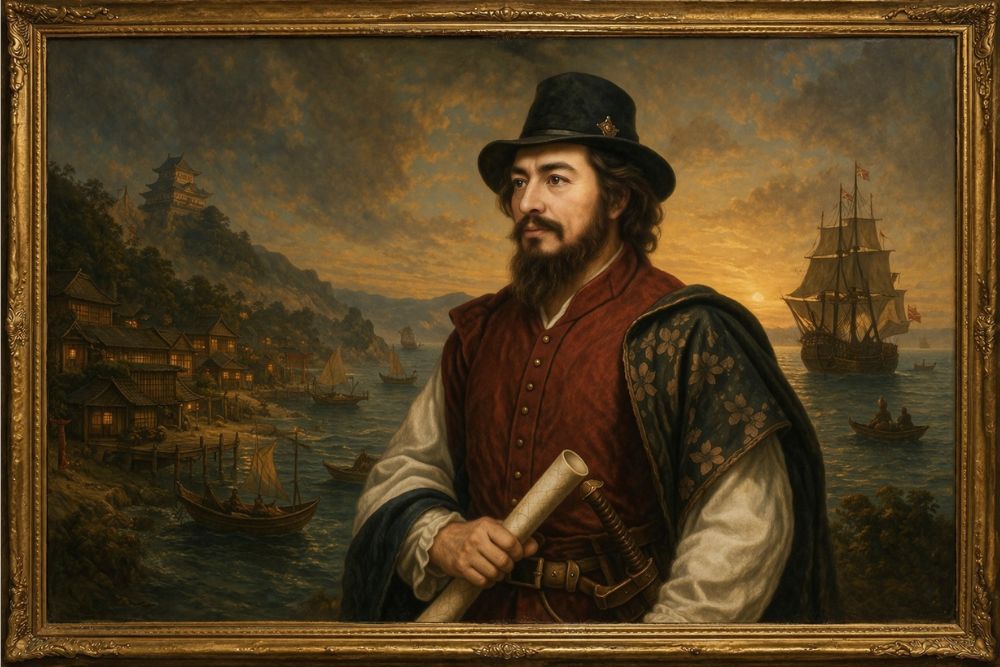
He left England as a ship’s navigator and ended up as a feudal lord in Japan. The true story of William Adams is stranger — and more moving — than any fiction.
Picture the scene. It’s April 1600, and a battered Dutch ship crawls into a harbour on the coast of Japan. The crew are so weakened by scurvy and starvation that they can barely stand. Of the five ships that set out from the Netherlands nearly two years earlier, this is the only one that made it. Of the 110 men who started the voyage, only 24 are still breathing.
Among the survivors is the ship’s navigator — a 36-year-old man from Gillingham in Kent named William Adams. He has no idea that he will never go home.
What happens next is one of the most extraordinary stories in British history — one that most people in Britain have never heard of.
From the Medway to the edge of the world
Adams grew up in Gillingham, just a stone’s throw from the Medway dockyards that were the beating heart of English naval power. He was apprenticed to a shipwright at 12, spent his teenage years learning to build and navigate vessels, and by his late twenties had served in the Royal Navy during the Spanish Armada. He married, had kids, and settled into a solid life as a merchant mariner.
Then, in 1598, he took a job as chief navigator on a Dutch expedition to the Spice Islands. Five ships, big ambitions, and a route that would take them around the tip of South America and across the Pacific. What could go wrong?
Almost everything, as it turned out. Storms battered them in the Atlantic. Scurvy swept through the crew. The Spanish and Portuguese — who controlled the sea routes and had no interest in Protestant competition — attacked them. Three ships were lost. A fourth deserted. By the time the lone survivor, the Liefde, limped into Japanese waters, it was a miracle it was floating at all.
The most powerful man in Japan liked him
The arrival of a European ship wasn’t unusual in Japan by 1600 — the Portuguese had been trading there for decades, and Jesuit missionaries had established a real foothold at court. And those Jesuits immediately moved to have Adams and his crew arrested as pirates and heretics. For a few weeks, things looked very bad indeed.
Then Adams was summoned to meet Tokugawa Ieyasu.
Ieyasu was, at this exact moment, consolidating his grip on power ahead of what would become the decisive Battle of Sekigahara. He was shrewd, curious, and deeply suspicious of the Catholic powers that had been filling Japan with missionaries. And this blunt English Protestant who could build ships, navigate by the stars, and explain European politics without an agenda? Ieyasu was fascinated.
“This man is a good man and not a criminal. He should not be executed.”— Tokugawa Ieyasu, on William Adams, c. 1600
They talked for hours across multiple meetings. Adams explained the wars between Catholic and Protestant Europe, described how Dutch and English trade worked, demonstrated navigational mathematics. Ieyasu listened. And when the Jesuits renewed their petition for Adams to be executed, Ieyasu refused.
Building ships — and a new life
Ieyasu had a problem. Japan was an island nation with no tradition of building the large oceangoing vessels that European powers were using to dominate global trade. Adams could fix that. Within a few years, he had supervised the construction of Japan’s first two Western-style sailing ships — an 80-ton vessel in 1604, a larger 120-ton ship in 1605. Ieyasu was delighted.
Did you know? The ships Adams built for Japan are considered the first Western-style oceangoing vessels ever constructed in the country — a genuine technological transfer that changed Japan’s maritime capabilities overnight.
The reward was staggering. Ieyasu granted Adams an estate on the Miura Peninsula, a stipend, around 80 servants, and — most remarkably — the status of hatamoto samurai. This wasn’t a honorary title or a pat on the back. It made Adams a direct retainer of the shogun, with all the social standing that implied. He became, officially and legally, a member of Japan’s warrior class.
Ieyasu also gave him a Japanese name: Miura Anjin — the Pilot of Miura. It’s the name the Japanese still use for him today.
The letter home that breaks your heart
There was a catch. Ieyasu refused to let Adams leave Japan. When a Dutch ship arrived in 1611 and Adams pleaded for permission to go home, the shogun said no. When he begged again, the answer was still no.
Adams wrote letters to England — careful, plainspoken letters that survive today in the British Library. In one, he writes simply: “I am not able to come from Japon.” In another, he asks friends to look after his wife Mary and their children. He sent what money he could. He never saw them again.
“I am as a fish out of water in all that concerns me here.”— William Adams, letter home, c. 1611
Slowly, though, Adams built a second life. He took a Japanese wife, Oyuki, with whom he had two children. He learned the language. He became a merchant trader, sailing to Siam and Vietnam on behalf of Dutch commercial interests. He helped negotiate the first English trading concession in Japan, in 1613. He became, in all meaningful ways, a man of two worlds.
Why doesn’t anyone know his name?
Adams died at Hirado in May 1620, aged around 55. In his will, he divided his estate between his English family and his Japanese family — a final, characteristic act of a man who had never quite belonged to either world, and had made a home in both.
In Japan, he’s still celebrated. There’s a park and annual festival in Yokosuka where his estate once stood. The city of Ito, where he built the shogun’s ships, has a statue. He appears prominently in Japanese history education.
In Britain? Most people have never heard of him. There’s a small memorial plaque in Gillingham. He got a brief burst of fame when James Clavell based the character of John Blackthorne in his 1975 novel Shōgun on him (and a more recent TV adaptation brought renewed interest). But he’s never really entered the national consciousness the way he deserves.
That seems like a shame. Because William Adams — shipwright’s apprentice from Kent, Royal Navy veteran, Dutch East India Company pilot, samurai lord — is exactly the kind of figure that history throws up every now and then to remind you that real lives are always stranger, and richer, than the stories we tell about them.
< BACK